Scottish Enterprise Appointment Round - Good Practice in Early Engagement and Planning (2023)
Background
Scottish Enterprise is an executive non-departmental public body. Their aim is to deliver a significant and lasting effect on the Scottish economy, and their work with the public and private sector helps businesses innovate and scale. Some of their activities include:
business development and advice
innovation support
investing in projects and
scale-up support.
This appointment round was set up in October 2022 and sought to find four board members. At the time the board was also running a separate round to appoint a new chair, and so this members round was led by the Interim Chair of Scottish Enterprise at the time. Joining the panel was Scottish Government’s Deputy Director for Regional Economic Development, the Ethical Standards Commissioner’s (ESC’s) Representative and an Independent Panel Member (IPM). The Code of Practice for Ministerial Appointments to Public Bodies in Scotland 2022 encourages the use of IPM’s, with the Code’s Statutory Guidance highlighting that Independent panel members can offer a constructively critical perspective to the panel’s deliberations. For Scottish Enterprise in particular, the IPM was able to offer relevant and insightful industry experience. Good practice during the round was seen particularly during the early engagement and planning phases, where early thought was given to the attraction strategy and how to manage assessment of an unprecedented number of applicants.
Early Engagement
Early engagement occurs before the formal planning phase of an appointment round. It is an opportunity for panel members to discuss the needs of the board and to assess the effectiveness of succession planning undertaken by the board. Early engagement activity will look different for each appointment round as the needs of the board vary. The panel for the Scottish Enterprise round utilised this opportunity to its fullest and used early engagement to discuss the board needs in addition to some early proposals about its attraction strategy.
The panel established during early engagement that Scottish Enterprise were in the process of reviewing and updating their Board Skills Matrix, and as a result the selection panel would need extended discussions during the planning phase to understand the board’s current needs, to adequately inform development of the person specification. Establishing this during this early stage of the process has the added benefit of allowing the panel to ensure there is adequate time scheduled in for planning and development of the person specification.
The panel also agreed during early engagement that promotion of the opportunities should begin before they were live, to generate interest. The ESC’s representative on the board noted in their end of round reflections that the ‘teaser’ [publicity] was around the opportunity to shape SE’s future, joining a diverse organisation and impacting Scotland’s economic success, rather than being specific about what the roles required at this stage.
It is clear that the panel understood some of the challenges they would face during this appointment round (understanding and attracting the skills required for four member roles) and used early engagement creatively and effectively as they moved into the formal planning phase. They identified the benefits of early publicity to generate interest in the roles before they were open to applications.
Planning
The planning phase focused on continued discussion about the attraction strategy, and the criteria required for the four roles. Establishing the criteria for the roles proved to be a more challenging aspect of the round, and the panel demonstrated good practice in recognising that planning is a phase of the process and not limited to one singular meeting. The planning meeting took place over the festive period, adding another challenge of panel availability. As such, at the conclusion of the first planning meeting it was clear that further work was required to finalise and identify the current needs of the board, and the resulting criteria that would be required. Communication continued beyond the meeting and the panel were able, through their effective communication, to create a person specification that outlined clearly the criteria required without any unnecessary restrictions.
Outreach
A comprehensive publicity plan was developed with clear objectives and targets. This included a vlog from the Interim Chair and another board member, which was released on social media channels.
In addition to the usual circulation list for public appointments utilised by the Scottish Government’s Public Appointments Team, a targeted approach was also taken as part of the round’s publicity strategy. This included outreach to industry organisations and trade partners. Members of the Enterprise and Skills Strategic Board were made aware of the opportunities in addition to the selection panel, board members of Scottish Enterprise and senior executives within Scottish Enterprise circulating the opportunities across appropriate networks. Finally, Scottish Enterprise also worked with Changing the Chemistry to offer an online outreach event, which took the form of a Q&A with the Interim Chair and other members of the board.
Ultimately, 95 applications were received and end of round reporting for the round indicated that applications were generally of a high quality.
Assessment Methods
Due to the unexpected and unprecedented high number of applications, the panel took several steps to effectively manage shortlisting. Access to applications was given to the panel early, to give them time to work through them. Additionally, despite scheduling a three hour shortlisting meeting, an additional meeting was also scheduled as a contingency in case three hours was not enough. This allowed the panel to meet the timetable as published in the applicant pack, ensuring that applicant expectations around when they could expect to hear the results of shortlisting were met.
Due to the quality of applications received and resulting number of shortlisted candidates, interviews were held over three days. Appointing four members at once can be a complex task where different criteria are required. The panel recognised that a variety of priority criteria was evidenced by candidates, and the ESC’s representative produced a tracking spreadsheet to clearly show candidates’ evidence against their chosen priority criteria, any other strength indicators they had highlighted as well as their evidence against the general criteria had been scored at shortlisting. This was ultimately a valuable tool for assisting the panel during their deliberations. Interviews were held face to face with the exception of one where a request was made for online due to availability of the candidate. This request was accommodated and demonstrates a flexible and applicant focussed approach.
Due to the strength of field, a Code Variation request was made to the Ethical Standards Commissioner, to increase the number of appointments from four members to five. This was granted on the basis of strength of field. Additionally, another candidate who demonstrated clear potential but was unsuccessful at interview was offered the opportunity by Scottish Enterprise to develop that potential.
Applicant Survey
An applicant survey was carried out approximately two months after the announcement that an appointment had been made. The survey had a strong response rate at 30% with 93% of responders providing demographic data. The diversity statistics provided were also encouraging, with 21% female; 25% under 50; 11% ethnic minority; 25% disabled; 4% LGBT and 36% first time applicants. It should be noted that this only includes those who chose to respond and is therefore only a snapshot view of those who applied.
75% of applicants who responded to the survey felt that it sounded like the body was looking for someone like them, which encouraged them to apply. A further 39% felt that the advert made the role sound attractive. 100% of applicants who responded felt that the applicant pack contained all the details they needed to apply and 89% felt that the requirements of the role were clearly set out in the applicant pack. 93% felt that the amount of information supplied at application stage was just right and 93% felt that the overall application process was clear.
These positive responses may well reflect the positive work that was put into creating a robust outreach strategy with an applicant pack that clearly outlined the requirements of the roles.
Successes
This was a successful round with plenty of good practice demonstrated throughout. Starting off with a robust and thorough early engagement meeting which covered the board’s current needs and skills gaps, while also allowing the panel to sow the seeds of their publicity and outreach strategy at an early stage. The criteria for the roles ultimately agreed on, although challenging to define, resulted in the identification of priority and general criteria, clearly aligned to the needs of the board whilst also ensuring that no unnecessary requirements were asked of applicants, ensuring that the pool of applicants was not unnecessarily restricted.
High level management information data has been provided for the round, including information about where applicants found out about the opportunity. In particular the importance of word of mouth and social media made a significant impact on where applicants found out about the opportunity, and reflects some of the work done by the panel in requesting that individuals close to Scottish Enterprise share the opportunities with their networks. This may also reflect the early ‘teaser’ and the fact that potential applicants were made aware of the opportunities early, so there was more time to be aware of them, even if the full detail was not made available at that early stage.
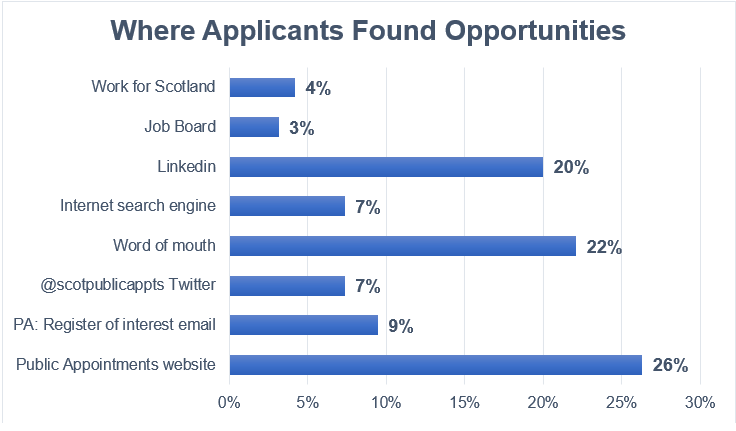
Additionally, the Public Appointments register of interest email that was circulated received 2110 clicks and 6 posts on X (formerly Twitter) advertising the opportunity received 238 interactions.
Key Learning
The key success for this round was the level of detail and attention dedicated to its creative publicity strategy (including the early ‘teaser’), in addition to the panel’s determination to ensure that the criteria for the roles was clearly defined and communicated. The round had a clear applicant focus from early engagement through the assessment, and it is encouraging that an additional appointment was made due to the strength of field of those who applied. Furthermore, it is especially encouraging that a candidate with clear potential received follow up and support from Scottish Enterprise to develop that potential which will aid in succession planning for future rounds for the body.
The panel also showed an ability to work flexibility when challenges arose, particularly in managing the shortlist of 95 applications, many of which were of a high quality, by adding contingency meetings to their shortlisting to ensure the deadline for communicating with applications was met.
Outcome
The successful appointment was announced on 5 June 2023:
12 Months On
12 months following the appointment, the Scottish Enterprise Board Chair was asked to complete a survey seeking views on what difference the appointments have made to the board. The ESC is particularly interested in the difference appointments make to the work of the board in relation to board behaviour, board impact and board measures development (i.e. how the board knows it is working). The 12 month on survey also helps to establish how far any key objectives of the appointment round were met, which in this round was to appoint members who could fill the identified gaps in the board’s skills matrix. The board Chair outlines that the new board members followed an induction process involving the Chair, CEO of Scottish Enterprise and Scottish Government Sponsor Teams. The Chair notes that the board’s understanding of diversity has strongly improved with the addition of the successful candidates, and that significant positive changes have been made to the board because of their appointments.