Scottish Funding Council Appointment Round - Good Practice in Lessons Learned (2025)
Background
This round, which first commenced in September 2024, sought a new chair for the Scottish Funding Council. Despite some challenges faced by the panel throughout, including ongoing wider sector reform and an initial failed first attempt at attracting individuals with the required skills for the role, it was ultimately successful. This may have been a result of, in part, the consideration and implementation of learning by the selection panel, and a redesigned and extensive publicity strategy.
The Scottish Funding Council (SFC) are responsible for sustaining the provision of higher and further education in Scotland. The SFC holds colleges, universities and other funded bodies to account for their delivery of required outcomes. They are also the statistical authority for colleges, and work closely with the UK-wide Higher Education Statistical Authority (HESA), providing data and statistics for government, decision-makers, and the wider public. At the time of this appointment round, the education and skills sector was on a transformation journey and undergoing reform. The Tertiary Education and Training (Funding and Governance) (Scotland) Bill was also introduced shortly after planning for the round commenced. This legislation also had the potential to impact the work of the SFC, meaning that the appointment was being made during a period of significant change.
From the Minister for Higher and Further Education in his letter to potential applicants: We are now seeking an exceptional candidate to play a leading role in driving that continuous improvement and transformation across the sector and to provide oversight and assurance as SFC delivers its existing statutory commitments. As SFC Chair, you will build on your leadership experience to drive reform forward in line with Ministerial priorities, championing reform within SFC and across the post-school landscape.
At the time of the appointment process getting underway, the SFC board was made up of 14 non-executive members and a chair who was approaching the end of their term. A first attempt at finding a new chair commenced in September 2024 but was unfortunately unsuccessful in securing any shortlisted applicants. The re-run of the round commenced in February 2025.
Early engagement
Identifying a new chair can be a challenging process for any public body. The general roles and responsibilities of a chair include leadership and ultimate accountability for the board and its decisions. Often these roles require more time than that of a board member, and they can come with greater levels of public scrutiny. Indeed, the time commitment required for the SFC chair requires 104 days per year, meaning that from the outset the pool of applicants able to take up the role may be limited or different to some other chair roles. Identifying the criteria required for a chair role when it arises is therefore a crucial part of the planning process. The first attempt at finding a chair for the Scottish Funding Council began in September 2024. However, it was ultimately unsuccessful with no applicants being shortlisted for the role.
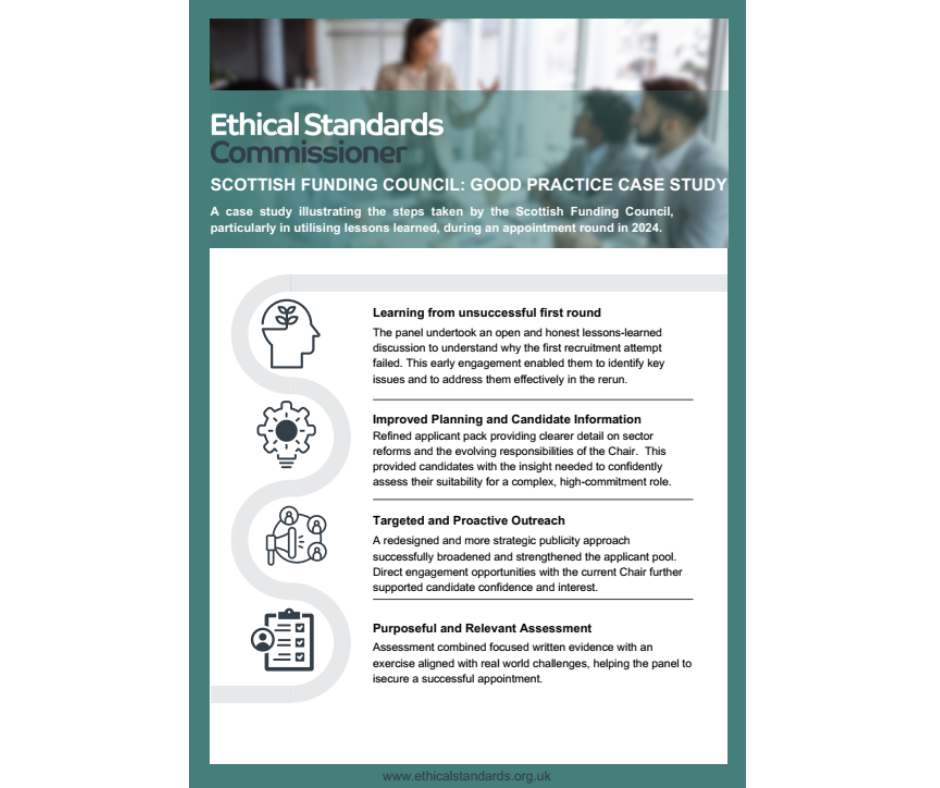
As a result, the selection panel agreed that a lessons learned discussion would help them to identify the reasons for the round’s failure, and to reconsider the criteria if necessary. This formed part of the early engagement discussions for the round rerun in February 2025.
The panel chair facilitated a candid and open discussion about what had gone well and what could be improved involving panel members, PAT and the sponsor team. It was agreed that the following factors went well:
- Consideration of the future requirements of the SFC and the Chair role
- Based on the above, the development of four essential criteria for selection
- The application evidence requested to enable effective shortlisting whilst not creating an unnecessary barrier for applicants
And these factors could have contributed to the failure of the first round:
- advertising over the festive period
- lack of targeted outreach given the role requirements
- lack of clarity and information on proposed reform in the education sector (potentially impacting the role of the SFC and therefore the responsibilities of the SFC Chair)
Several actions were identified and agreed to improve the rerun. These included:
- ensuring the reform process was clearly outlined in the pack including what it would mean for the SFC and its impact on the Chair role
- developing a more targeted and proactive outreach strategy given that the size and time commitment for the role is more substantial than many other Chair roles
The selection panel also drew on a good practice case study for the Scottish Qualifications Authority in their post-round lessons learned meeting. This helped to inform both actions above as the SQA was also subject to ongoing reform and transformation at the time and is also in the education sector.
Planning & Outreach
The panel chair was clear that the original criteria identified for the role was correct, and felt it was important that the criteria were not diluted for the rerun. The person specification therefore remained the same but the applicant information pack was redeveloped based on learning during early engagement and further consideration of what would be helpful to include from the applicant’s perspective.
As part of this the panel sought to ensure that applicants had enough information to fully consider whether the role was a right fit for them, particularly in relation to the wider sector reform and its impact on the chair role. By February 2025 further information had been agreed by Ministers relating to the direction of reform, and so the panel were able to more fully communicate how this would impact the SFC and its board. A letter from the appointing minister inviting applicants to apply, which had been included in the first round, was enhanced with this additional information.
Applicants were also offered the opportunity to speak directly with the current chair of the SFC, about the role and the body more generally.
Early informal communication about the vacancy through government and education networks was also agreed, and this began prior to publication of the advert. An extensive social media campaign took place which was led by the body itself. The body’s sponsor team and the selection panel members also ensured that the position was shared across their own networks using the advert which had been re-worded to be more future-focused and purpose-led to attract the target audience.
Assessment methods
The first stage of assessment involved a written application in which applicants had to provide evidence against three essential criteria. A tailored career/life history was also required from applicants. The re-run attracted a greater number of applicants, and end of round reporting suggests that they were of better quality than those received during the first run of the round. Half of the applications provided sufficient evidence to be shortlisted for the role.
The second stage of assessment included a pre-prepared exercise and traditional interview style questions. The pre-prepared exercise was designed carefully by the selection panel, who asked candidates how they, as chair, would lead the board to develop and oversee a vision for a reformed SFC. This chosen assessment method was purposeful, given the ongoing reform underway with would impact the SFC.
Successes – particularly in learning from previous round
This was a successful round with good practice demonstrated particularly well in the early engagement phase, where the panel allowed sufficient time to consider and implement lessons learned from the prior unsuccessful round. This ensured that the panel were aligned in their understanding of why the prior round might have failed, and how to approach the planning phase of the re-run differently. By prioritising this learning early on, the panel could focus their time on actions that would most likely improve the outcome of the re-run round.
The publicity plan in particular was thoroughly considered. This included early outreach through networks, a extensive social media campaign and a redesigned applicant information pack and letter from the Minister that was more candidate-focused.
Key learning – how to approach a rerun
This round was particularly successful in identifying ways to improve the process to secure a more successful outcome. The panel worked well together throughout the process, identifying and implementing learning, and challenged where appropriate to identify the most meritorious individual for the role.
The learning approach demonstrated by the panel during the planning phase is highlighted. This included a full and open discussion on lessons learned from the unsuccessful round as well as use of a good practice case study produced for the Scottish Qualifications Authority. This is likely to have contributed to a different and successful outcome for the re-run.
Outcome
The successful appointment was announced on 3 July 2025.